Posts

The Productive Reader - Read 30/Think 30
Image
I was trying to come up with a creative process that would yield better reading comprehension. I always work best in one hour blocks, which allows me not to invest so much time on one project. I get carried away sometimes and forget I have other projects I need to complete. The reading portion of this exercise is pretty straight forward. Get timer set it for 30 mins and just read. As usual, stay in constant dialogue as you read. Annotate your text. Underline or make passage that are intriguing, circle words that are unfamiliar. So pretty much do what you do. I would find my self reading for an hour straight and not really getting involved with the text. I would jump of after reading and really never let the information soak in. So I needed to develop a process that was efficient for future projects involving the information I was reading. The key here, was thinking ahead. I would spend more time rescanning a text if I didn't take the time to organize my thoughts after reading. Be...

Henry James ~ The Ambassadors: A study at 5 pages a day

Image
Recently, I finished a seminar on Henry James. The class read some very intense novels: such as. The Bostonians and The Wings of the Dove. I was disappointed that we didn't read The Ambassadors. So I asked my professor why. She said it was a very challenging novel that needs to be read at a pace of 5 pages a day. So that sounded like a fun challenge for the summer. So after I walk across the stage I will be picking up Henry James' The Ambassadors and venturing into a 5 page a day experiment. I will be reading the Norton Critical Edition 335 pages which = 65 days.

Education and Frustration

Where I stand. I'm trying not to be bitter. So if I sound that way, I apologize. I recently failed to get accepted into a graduate program that I really wanted to get into. I feel that I'm qualified and understand their reasoning. I have applied to other schools as well. However, I seriously thinking about hanging it up. I cannot afford to take post bat classes. So what to do now? Well I'm considering not going to graduate school at all. I have a chance to work a decent job that will not interfere with my evenings and I also have a chance to do quite a bit of substitute teaching. I really don't want to get my teaching certificate, for I have a hard time dealing with authority. I'm sure as hell not going to be teaching toward a test. I really want to take some time to refocus and build stronger writing skills and get better at grammar and diction. I had this great idea. Why not become purely self taught. Nothing against higher education, and I have all the respect ...

How to write a lot (I wish)

I was recently perusing the inteweb looking for books on writing and found How to Write a Lot:   A Practical Guide to Productive Academic Writing by Paul J. Silvia. I love reference books on writing as they are a enjoyable procrastination reads. I was reading some reviews on the book and found this interesting bit on AMAZON and thought I would publish it here.  Hello, my name is Renee. I am an assistant professor and a mother. I write a lot. I inherited this book from a friend who didn't get tenure. I find books on writing valuable, because even though I write a lot, there's always something to learn from others who write a lot. This book was interesting and easy to read. It was funny, and I share the author's interest in mid-century furniture (although I am not sure it is relevant to writing!). I would recommend it to people who want to read a useful text on writing productively. However, I am giving this text only three stars because the advice is rather thin, an...

A Portrait of the Artist as a Young Man ~ James Joyce

Image
I recently  picked  up Ulysses and felt like I probably should read  A Portrait of the Artist as a Young Man before fully jumping into Ulysses. My experience with Joyce before this novel was his short story “The Dead” from his collection The Dubliners. I remember absolutely enjoying “The Dead,” but like most readers, who approach Ulysses for the first time,I felt a little overwhelmed. I am a big fan of stream-of-conscious narration. Virginia Woolf and William Faulkner are two of my favorite Modernist writers. Further, as a fan of serious literature, I need to conquer Joyce at somepoint (and prepare for my intense Faulkner course next semester).  So now, onto this fine piece of literary experimentation. Joyce’s   A Portrait of the Artist as a Young Man  poses basic questions about the human condition. A coming-of-age story in its truest sense, Stephen Dedalus finds himself asking and pondering some life’s most trivial questions. These questions, ho...

Classics Club Book List

http://theclassicsclubblog.wordpress.com/ Here it is. Finally, My Classics Club Book List. There are several key titles missing, well that is because I have read those. I do plan to review each book and also back track and review the classics I have read. I would like to complete this list by December, 12, 2017 five years. I'm sure that many more will fall into this list. Achebe, Chinua: Things Fall Apart Anderson, Sherwood: Winesburg, Ohio Austen, Jane: Emma Austen, Jane: Pride and Prejudice Bellow, Saul: Herzog Bellow, Saul: The Adventures of Augie March Bellow, Saul: Henderson the Rain King Bellow, Saul: Seize the Day Bradbury, Ray: Fahrenheit 451 Bradbury, Ray: The Illustrated Man Bronte, Charlotte: Jane Eyre Browning, Elizabeth Barrett: Aurora Leigh Burke, Edmund: A Philosophical Enquiry Carroll, Lewis: Alice in Wonderland Cather, Willa: A Lost Lady Cather, Willa: My Antonia Cather, Willa: Death Comes for the Archbishop Cather, Willa: Lucy Gayheart ...

Epistemological, Espistemology, Episteme

Episetmology : the study or a theory of the nature and grounds of knowledge especially with reference to its limits and validity. From Greek: Episteme OED: Epistemological, n.   The theory or science of the method or grounds of knowledge. 1856   J. F. Ferrier Inst. Metaphysic 48   This section of the science is properly termed the Epistemology..It answers the general question, ‘What is Knowing and the Known?’ or more shortly, ‘What is Knowledge?’ 1883   Athenæum 20 Oct. 492/3   He divides his work into four sections, dealing with epistemology, ontology, anthropology, and ethics. This word has often come in essay relating to Blood Meridian and Episteme is often used by Micheal Foucault. Episteme : This term, which Foucault introduces in his book The Order of Things , refers to the orderly 'unconscious' structures underlying the production of scientific knowledge in a particular time and place. It is the 'epistemological...

Live Blog: Blood Meridian Part Two

Image
By Inenarrable "And they are dancing, the board floor slamming under the jackboots and the fiddlers grinning hideously over their canted pieces. Towering over them all is the judge and he is naked dancing, his small feet lively and quick and now in doubletime and bowing to the ladies, huge and pale and hairless, like an enormous infant. He never sleeps, he says. He says he’ll never die. He bows to the fiddlers and sashays backwards and throws back his head and laughs deep in his throat and he is a great favorite, the judge. He wafts his hat and the lunar dome of his skull passes palely under the lamps and he swings about and takes possession of one of the fiddles and he pirouettes and makes a pass, two passes, dancing and fiddling all at once. His feet are light and nimble. He never sleeps. He says that he will never die. He dances in light and in shadow and he is a great favorite. He never sleeps, the judge. He is dancing, dancing. He says that he will never...

WORDS

Image
  "surrealism, n.". OED Online . June 2012. Oxford University Press. 16 June 2012.  A movement in art and literature seeking to express the subconscious mind by any of a number of different techniques, including the irrational juxtaposition of realistic images, the creation of mysterious symbols, and automatism ; art or literature produced by or reminiscent of this movement. The term surréalisme , coined by Guillaume Apollinaire, was taken over by the poet André Breton as the name of the movement, which he launched with his Manifeste du Surréalisme in 1924; his statement there of the term's meaning is given in quote 1935.  "S urrealism , pure psychic automatism, by which it is intended to express, verbally, in writing, or by other means, the real process of thought" ( D. Gascoyne tr. A. Breton in Short Surv. Surrealism iv. 61).  Hyperrealism, n.  A style in art that attempts to reproduce highly realistic graphic representatio...

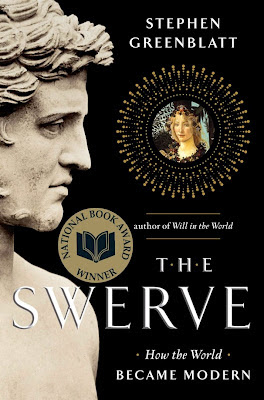
The Swerve by Stephen Greenblatt

Image
Winner of the 2012 Pulitzer Prize for General Nonfiction The Swerve by Stephen Greenblatt reconstructs history by showing the reader the reciprocal effect history and literature has on each other. Greenblatt re-imagines a time when human civilization was emerging from the darkness by reaching back to the past and uncovering the creation of the Renaissance and the Humanist’s movement. What Greenblatt initially reveals is the beginning of the Early Modern Period through ancient text. This book strikes a chord for book lovers, scholars; classicist, early modernist, and even modern scholars. It conjures up a late medieval romance of digging through monasteries and hidden chambers of West’s past. This book works as a retelling of an archeological process illuminating a story that has shaped the way our modern minds think. The struggle of a secular society versus a religious society. It explores atheism, Christianity, Paganism. Blending per-Christian ideas with a dominating Roman Catholic i...

Pragmatic Overtones in Cormac McCarthy’s The Orchard Keeper

Image
 I n Walter Sullivan’s 1965 review of Cormac McCarthy’s first novel The Orchard Keeper, Sullivan claims McCarthy’s novel takes shape in “the middle of the agrarian influence” (721). This quote sends up a flare within the McCarthy community of scholars, who continue to debate Sullivan’s claims. Sullivan also acknowledges that McCarthy can be read as an author who has “had enough sense to see in the land a source of human salvation. [McCarthy] is a kind of anachronism who celebrates the traditional values in the traditional way” (721). However, many recent scholars disagree with Sullivan’s claims about the “land as a source of human salvation.” In her book Reading the World: Cormac McCarthy’s Tennessee Period, Dianne Luce states that, “[i]t is a mistake either to confuse East Tennessee with the plantation South or to label McCarthy a latter-day Agrarian” (271). In making this comment, she also argues that The Orchard Keeper can be read “in the context of the classic Southern A...